
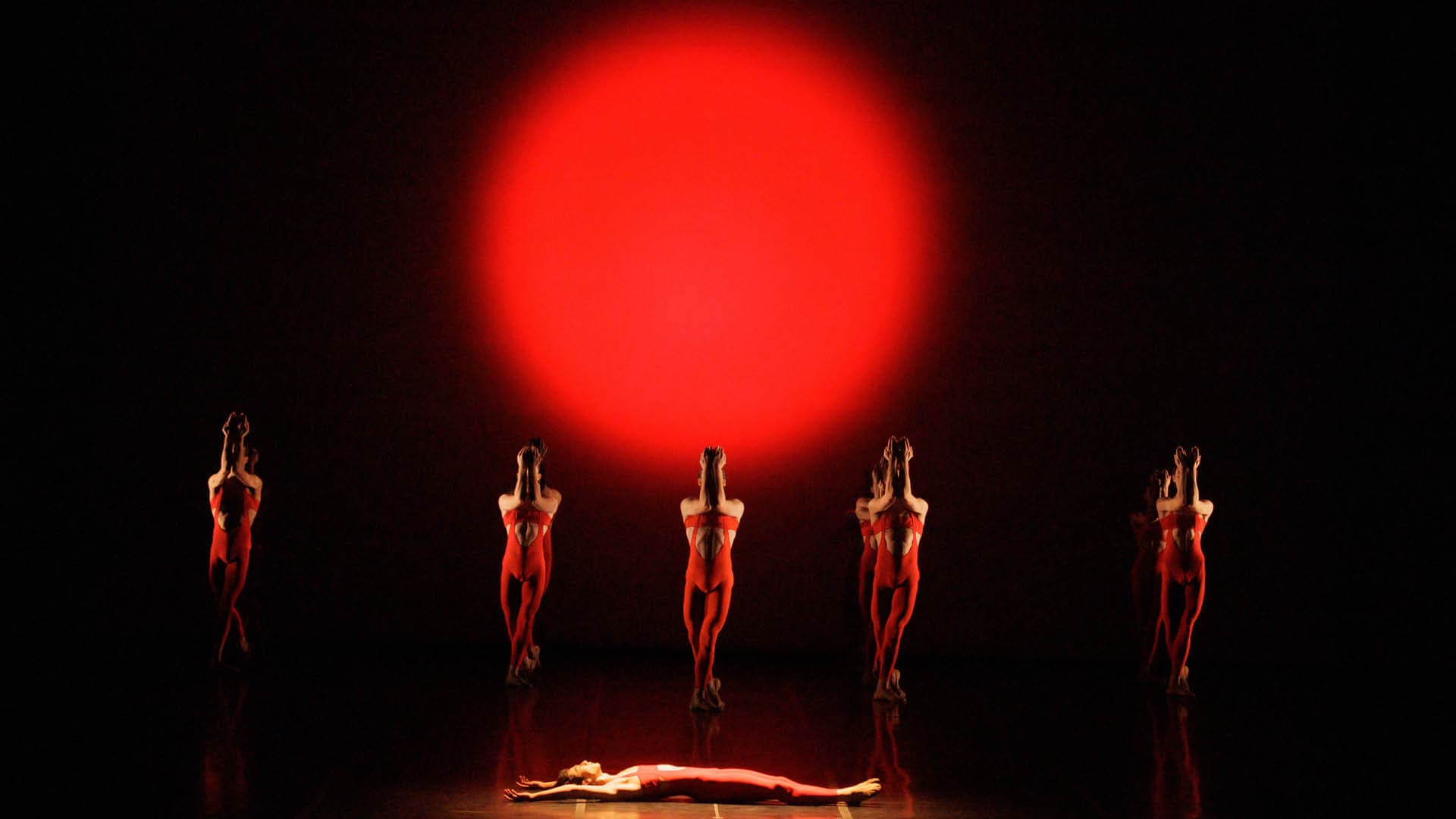
Béjart Ballet Lausanne
The 100th Anniversary of Maurice Béjart
From Thu 11.11.2027
To celebrate 100 years of Maurice Béjart and 40 years of Béjart Ballet Lausanne, the company returns to Forest National with three landmark works: Boléro, The Rite of Spring, and The Firebird.

In 2027, the Béjart Ballet Lausanne celebrates an exceptional double anniversary: 100 years since the birth of Maurice Béjart (1927–2007) and 40 years since the company was founded in 1987. To mark these milestones, the world-renowned company returns to Forest National in Brussels, a city that played a crucial role in Béjart’s career and artistic development. From 11 to 14 November 2027, the ballet company will present an exclusive programme featuring three iconic works from Maurice Béjart’s repertoire, underlining his artistic vision and lasting influence on the world of dance: Boléro, Le Sacre du Printemps and L’Oiseau de Feu.
Forest National welcomes Béjart Ballet Lausanne with an exceptional anniversary programme
2027 will undoubtedly be the year of Maurice Béjart, marked by an extraordinary double anniversary: it will be exactly 100 years since his birth on 1 January 1927 in Marseille, and 40 years since the founding of the Béjart Ballet Lausanne. On this occasion, the company pays tribute to its founder through a major international tour in which the key works of its repertoire will be revived. The aim is to highlight that his legacy remains alive, universal and influential today — a heritage that has inspired an entire generation of choreographers and artists, still guided by his boldness, freedom and visionary spirit.
From 11 to 14 November 2027, the Béjart Ballet Lausanne presents an exceptional programme at Forest National as part of this double anniversary:
Boléro (1961) – Maurice Ravel
The programme opens with Boléro, one of Béjart’s most iconic choreographies set to the music of Maurice Ravel, which premiered in 1961 at the Royal Monnaie Theatre in Brussels. With its seemingly simple yet hypnotic structure, the work evolves into an intense collective experience, centred on rhythm and repetition.
Maurice Béjart defines his interpretation of Ravel’s work in the following terms: “Music that is overly familiar, yet always new thanks to its simplicity. A melody – of Eastern origin rather than Spanish – endlessly winds around itself, growing in volume and intensity, devouring sonic space and ultimately engulfing the melody itself.”
Without seeking to describe further what is an evident ballet in itself, it is worth noting that Maurice Béjart, in a very different style, aligns with the spirit of The Rite of Spring, in that—unlike most choreographers who previously interpreted Boléro—he rejects all external picturesque effects in order to express only, but with extraordinary force, the essential. Maurice Béjart entrusts the central role – the Melody – sometimes to a female dancer, sometimes to a male dancer. The Rhythm is performed by a group of dancers.
Le Sacre du Printemps (1959) – Igor Stravinsky
The programme continues with Le Sacre du Printemps, set to music by Igor Stravinsky, which premiered in 1959 at the Royal Monnaie Theatre in Brussels. In this powerful and physical choreography, Béjart translates the primal force of spring and human desire into a universal and timeless ritual, stripped of folklore and focused on the essence of human energy and connection.
L’Oiseau de Feu (1970) – Igor Stravinsky
Finally, L’Oiseau de Feu is presented, also set to music by Stravinsky, which premiered in 1970 at the Palais des Sports in Paris. In this abstract and expressive creation, Béjart highlights both the Russian roots and the revolutionary nature of the composer, with a choreography that breaks with traditional narrative and focuses on pure emotion and musical power.
With this return to Brussels and Forest National, the Béjart Ballet Lausanne pays tribute both to its founder and to the city that played a fundamental role in his artistic legacy.
Brussels, the creative birthplace of Maurice Béjart
“It is in Brussels that the essence of my choreographic creation was realised.” – Maurice Béjart
The connection between Maurice Béjart and Brussels is profound and decisive. After a pivotal encounter with Maurice Huisman, then director of the Royal Monnaie Theatre, he settled in the Belgian capital in 1959. A year later, he founded the Ballet du XXe siècle, which quickly became an international reference in the dance world.
In Brussels, he created some of his most iconic works, including Le Sacre du Printemps and Boléro, followed later by L’Oiseau de Feu and the Ninth Symphony, which marked the opening of Forest National. In 1970, Béjart also founded the Mudra School in Brussels, which trained a new generation of dancers and choreographers, including Anne Teresa De Keersmaeker, today one of Belgium’s most renowned choreographers. Thanks to his work, Brussels became an international centre for contemporary dance.
On 30 June 1987, he left Brussels for Lausanne, where he founded the Béjart Ballet Lausanne. He died in 2007 at the age of 80 on the shores of Lake Geneva. For more than twenty years, Brussels was considered the world capital of dance: all major dancers and choreographers wanted to pass through Mudra or collaborate with Béjart. This was also the most prolific period of his career, with around 250 creations out of a total of 370.
About Béjart Ballet Lausanne
Since its creation in 1987, Béjart Ballet Lausanne has developed into a leading international dance company and a living heir to the vision of Maurice Béjart. Today, the company is under the artistic direction of Julien Favreau, who, as a former soloist of the repertoire, embodies the continuity of Béjart’s work. From this foundation, he preserves the founder’s legacy while opening it up to a contemporary choreographic approach and new artistic impulses. Faithful to Béjart’s wish to make dance accessible to all, the company performs on the world’s greatest stages and continues to reach an ever wider audience through the expressive and universal power of its art.
Between 2007 and 2024, former Artistic Director Gil Roman contributed to shaping the further development of the company, through new creations and collaborations with guest choreographers from diverse backgrounds — Yuka Oishi, Valentina Turcu, Julio Arozarena, Tony Fabre, Christophe Garcia, Alonzo King, Giorgio Madia, Joost Vrouenraets and Sthan Kabat-Louët — whose distinct artistic languages have revealed the versatility of the dancers and further strengthened the artistic identity of Béjart Ballet Lausanne.
The repertoire — featuring key works such as Le Sacre du Printemps, Boléro, the Ninth Symphony and Le Presbytère n’a rien perdu de son charme, ni le jardin de son éclat — remains vibrantly alive. Today, under the artistic vision of Julien Favreau, Béjart Ballet Lausanne continues to be a space for creation and transmission, where the legacy of Maurice Béjart coexists with contemporary choreographic voices.
 be•at Premium
Tickets
- Thu 11.11.2027 20:0011Nov
2027Thu 20:00Forest National
- Fri 12.11.2027 20:0012Nov
2027Fri 20:00Forest National
- Sat 13.11.2027 20:0013Nov
2027Sat 20:00Forest National
- Sun 14.11.2027 15:0014Nov
2027Sun 15:00Forest National

At the box office, you pay an extra 2 euros service charge.Organizer: Gracia Live